1
Speed
Faster or slower, like tape, so the sample rings at the drum's rate. Not a pitch shift: the length has to change for the waves to line up.
Drum Match
Drum Match retunes and flips the sample under your live drum, so the two push in the same direction. More weight. Nothing fighting.
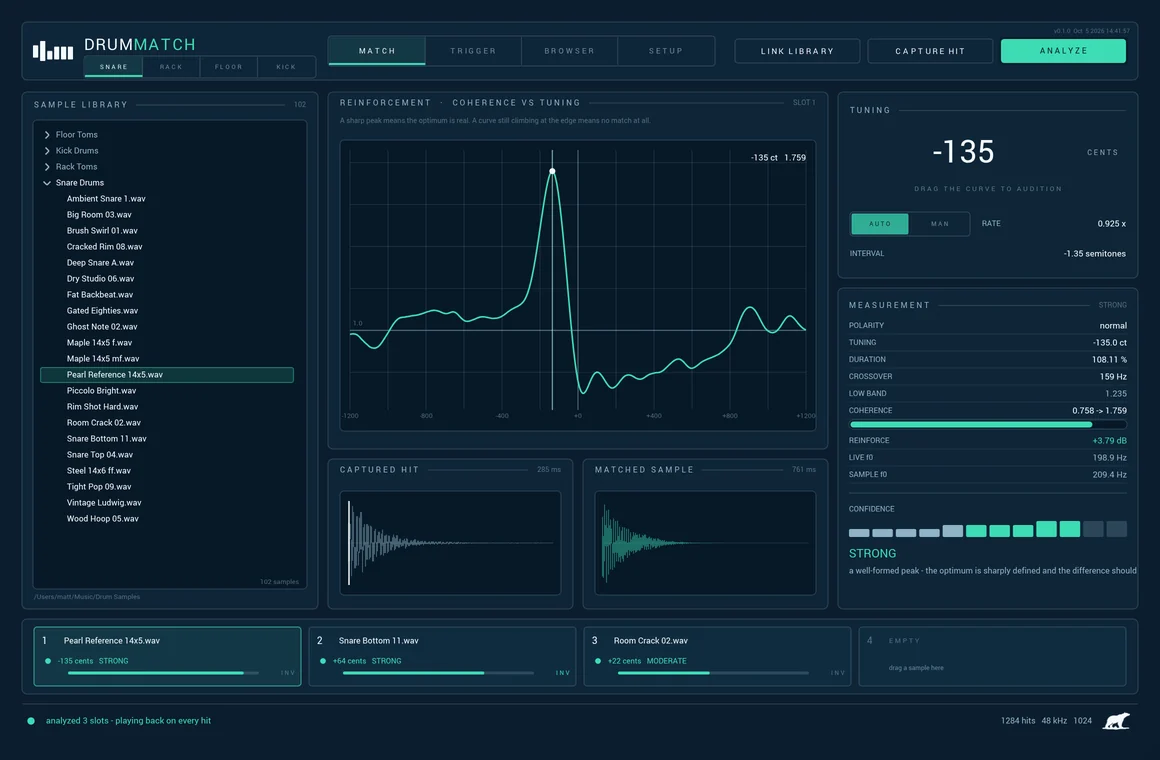
Coming first to macOS. VST3 and AAX, on Mac and Windows, to follow.
Lining up the first hit is not enough. Two drums almost never ring at the same rate, so a sample that starts in step drifts out of it within a few cycles. What you layered for punch quietly takes it away.
How it works
The transients start together, but this sample is upside down against the drum. Add the two and the hit gets smaller.
Now the first cycles push together. The sample rings a little fast, so by the tail it has drifted back out of step.
Played slightly slower, like tape, it rings at the drum's rate and stays in step to the end of the hit.
Listen
A live snare with a sample layered under it. Same hit, same sample. The only difference is the match.
Both versions play at equal loudness, the way the blind test was run, so you hear the match rather than more level. Turn it off to hear the natural difference.
Example 9 from the test set: a close-miked Pearl snare. The matched sample is Drum Match's own output, not a hand match. Headphones help.
What it changes
1
Faster or slower, like tape, so the sample rings at the drum's rate. Not a pitch shift: the length has to change for the waves to line up.
2
When a sample is the mirror of the drum, flipping it turns cancellation into reinforcement.
+7.7 dB from the flip alone, on one real pair.
3
Body and weight can want opposite things. Drum Match splits just under the drum's own pitch and decides each half on its own. The split adds back to exactly the original.
0.504 → 1.496 low-band coherence, worst pair.
Level stays at unity. Timing stays yours beyond aligning the transient. The live drum is never processed at all.
Some tuning always scores best. That does not make it good. If the curve has no clear peak, Drum Match reports No match and will not arm playback.
Close-miked. Up to four samples per drum, each matched on its own.
Tested by ear
In a blind test on thirteen unselected snare pairs, the matched sample was judged better than the untouched one every time.
The story
I've loved music since I was a kid, and these days I mix for a living as an audio engineer. Layering a sample under a live snare should add weight, but half the time it took some away, and the only fix was nudging tuning and polarity by ear, hit after hit, until the two stopped fighting.
Drum Match does that part. It measures what I was listening for, and it was tested the way I would have tested it: blind, by ear, against my own matches.
JoelPolar Bear Audio
One email when Drum Match is ready. No account, no card.
Your address is used to tell you when Drum Match is ready, and to invite you to test early builds only if you ask. Unsubscribe is in every email.
FAQ
It is for layering. Drum Match works on the sample you put under a live drum, so the two add up instead of fighting. The recorded drum is never touched.
No. It resamples, like changing tape speed, so length and pitch move together. The length is exactly what has to change for the waves to line up. Every hand-made reference match we studied turned out to be plain resampling.
No. Gain stays at unity. In every reference match an engineer made by hand, the level was never changed either.
It says so. If the reinforcement curve drifts instead of peaking, the best number is only less cancellation, not a match. Drum Match reports No match and leaves that slot unarmed.
It runs once per pairing, off the audio thread. During playback the plugin only plays a sample that has already been matched.
First release: Audio Unit on macOS, which covers Logic, Ableton Live, Reaper, Studio One and most other Mac DAWs. VST3 (Cubase, Nuendo) and AAX (Pro Tools) follow, then Windows. Tell us your DAW when you sign up and it helps us decide the order.
Drum Match is coming to the Mac first. One email when it is ready.